

Maintaining personal vehicles and home equipment requires dependable hand tools that can withstand serious torque without damaging stubborn fasteners. Working on modern suspensions, brake calipers, or engine bays quickly exposes the limitations of random loose wrenches and mismatched hardware. Equipping a residential workspace with an organized collection ensures you always have the exact socket size and drive configuration ready when an unexpected repair arises.
The market for automotive hand tools has evolved significantly in recent seasons, introducing ultra-fine gear mechanisms and specialized off-corner socket geometry that were once reserved strictly for commercial repair shops. However, many DIY mechanics still struggle with bloated piece counts that swap practical deep sockets for hundreds of tiny driver bits. Navigating through brand offerings from leading manufacturers like DEWALT, KingTool, CRAFTSMAN helps you secure durable tools without paying for filler components you will never use.
In this comprehensive guide to the Best Mechanics Tool Sets for Home Garages for September 2026, we analyze 7 top-tier packages designed to balance socket variety, mechanical leverage, and reliable case organization. Whether you are maintaining a family commuter or upgrading a modern hybrid vehicle, choosing the right toolkit protects both your knuckles and your vehicle hardware.


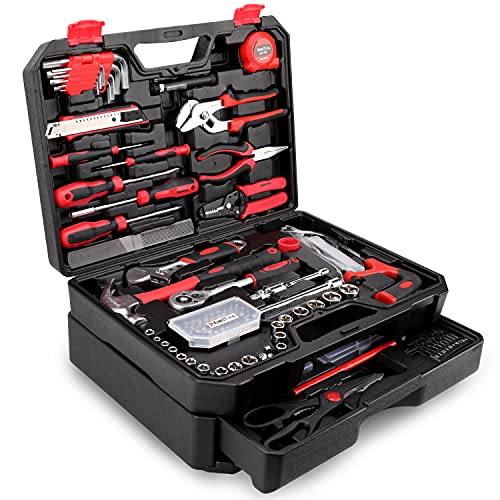
Ratchet Tooth Count and Arc Swing
The gear mechanism inside a ratchet head determines how much handle movement is required before the internal pawl catches the next tooth. Standard utility ratchets often utilize 36-tooth or 48-tooth designs that need up to ten degrees of swing space to operate properly. Modern automotive work in cramped engine bays demands higher gear densities to turn fasteners where clearance is restricted to just a few inches.
Fine-tooth ratchets featuring 72-tooth or 90-tooth gears reduce the required arc swing down to five degrees or four degrees respectively. This tighter swing angle allows you to engage fasteners behind steering columns, inside fender wells, and around air conditioning lines where full rotations are impossible. Low profile teardrop heads further enhance clearance by slipping into tight structural gaps without snagging nearby wiring harnesses.
As a rule of thumb, look for ratchets that balance high tooth counts with robust pawl engagement to prevent internal gear slipping under heavy load. A 72-tooth ratchet provides an ideal balance of tight-space accessibility and brute strength for general home garage applications. Choosing a 90-tooth mechanism offers supreme dexterity for specialized under-dash or suspension work where every fraction of an inch counts.
Three-Drive Size Coverage (1/4-Inch, 3/8-Inch, and 1/2-Inch)
A complete garage toolkit should provide sockets and ratchets across all three standard square drive sizes rather than relying on a single middle ground. Each drive standard handles specific mechanical stress thresholds and physical fastener diameters on a vehicle. Omitting either the smallest or largest drive leaves significant gaps in your repair capabilities when working on varied home machinery.
Quarter-inch drive components excel at light interior fasteners, sensor housings, and small engine assemblies where high torque would strip delicate aluminum threads. Three-eighths-inch drive serves as the primary workhorse for routine brake servicing, alternator replacements, and general chassis maintenance. Half-inch drive tools deliver the structural mass and leverage required for suspension pivot bolts, wheel lug nuts, and stubborn frame hardware.
When evaluating comprehensive sets, verify that all three drive sizes include matching ratchets and dedicated extension bars. Kits that only supply quarter-inch and three-eighths-inch drives will force you to purchase supplementary breaker bars and heavy sockets separately when tackling serious driveline repairs.
Socket Geometry: 6-Point vs. 12-Point Profiles
The internal broaching of a socket directly dictates how force transfers to the flat sides of a hexagonal bolt head. Six-point sockets make contact along the thick walls of the fastener flats, significantly reducing the likelihood of rounding off rusted hardware. Twelve-point sockets provide twice as many initial alignment angles, which speeds up socket placement in blind locations but increases the risk of slippage.
For general garage maintenance and automotive restoration, six-point sockets are vastly superior because they can handle high breakout torque on weathered bolts. Modern high-performance sockets also incorporate off-corner loading designs, such as DirectTorque geometry, which cut away the interior corners to concentrate rotational force purely on fastener flats. This engineering feature allows mechanics to apply maximum force to stubborn bolts without spreading the socket walls.
Ensure your primary socket assortment relies predominantly on six-point architecture for critical mechanical fasteners. Reserve twelve-point sockets specifically for specialty automotive applications like cylinder head bolts, driveline fasteners, or square hardware where twelve points of contact are mandatory.
Metric and SAE Measurement Balance
Working in a residential garage requires seamless transitions between standard fractional inch fasteners and modern metric dimensions. Most contemporary domestic and imported passenger cars utilize metric hardware across virtually all mechanical subsystems. Meanwhile, lawn tractors, utility trailers, and older home workshop equipment frequently rely on fractional SAE sizing.
A balanced mechanic set must provide parallel socket runs without skipping common intermediate sizes like 15mm, 18mm, or 5.5mm. Inexpensive tool packages frequently omit these essential sizes to cut manufacturing costs, leaving DIY mechanics stranded midway through routine brake or suspension jobs. Look for clear stamped markings that allow rapid identification under dim garage lighting instead of shallow laser etching that wears away over time.
Check our broader automotive and vehicles resources to learn how different mechanical disciplines balance specialized equipment. Before buying any set, inspect the manifest to ensure metric coverage runs continuously from 4mm up to at least 22mm without critical omissions.
Deep vs. Shallow Socket Distribution
Shallow sockets are essential for fitting into compact recesses where overhead clearance is minimal, such as inside alternator brackets and timing covers. However, many automotive tasks involve threaded studs that extend far past the retaining nut, such as exhaust manifold bolts, suspension top hats, and battery hold-downs. Standard shallow sockets bottom out against long studs before their internal broaching can engage the nut.
Deep well sockets provide extended internal clearance to accommodate protruding studs and deeply recessed spark plugs with ease. A high-value mechanics kit should supply deep sockets in both metric and SAE sizing for the most commonly encountered bolt diameters. Having both shallow and deep variants for core fastener sizes eliminates frustrating interruptions during complex assembly steps.
As a practical guideline, ensure your chosen set includes deep sockets for at least the 8mm through 19mm range in metric, as well as 5/16-inch through 3/4-inch in standard sizes. Sets that skimp on deep sockets often force you to rely on open-ended wrenches, which dramatically increases service time and knuckle fatigue.
Steel Alloy Quality and Corrosion Resistance
The metallurgical composition of hand tools dictates their tensile strength, fatigue resistance, and overall longevity under extreme torque loads. Professional-grade mechanics tools are forged from chrome vanadium steel or chrome molybdenum alloys that undergo precision heat treatment. This metallurgical process prevents ratchets from shearing and keeps socket walls from bulging under heavy leverage.
Surface finishing plays an equally vital role in defending tools against garage moisture, motor oil, road salt, and brake fluid. Full-polish chrome electroplating provides an ultra-smooth protective barrier that cleans off effortlessly with a shop rag after greasy jobs. In contrast, rough industrial finishes tend to trap dirt and moisture, accelerating surface rust and making size labels difficult to read.
Always inspect the plating quality around drive square corners and internal socket broaches where flaking chrome can contaminate delicate mechanical assemblies. A smooth, mirror-polished chrome vanadium finish guarantees reliable rust protection and ensures long-lasting performance throughout decades of residential garage use.
Storage Box Engineering and Drawer Organization
A massive tool collection is only as effective as its organization system, especially when working on time-sensitive automotive repairs. Traditional blow-molded clamshell cases frequently feature loose friction tabs that drop heavy sockets out of order every time the lid is closed. This results in disorganized piles of steel that waste valuable repair time as you search for missing sizes.
Modern storage solutions, such as multi-drawer chests and modular interlocking systems like VERSASTACK, keep tools separated into dedicated sliding compartments. Drawer-based cases allow you to access quarter-inch, three-eighths-inch, or half-inch drive tools independently without flipping over an entire heavy plastic suitcase. Spring-loaded locking dials and metal latches further ensure that drawers stay secured during transit in your vehicle trunk.
If you regularly organize your wider home and workshop spaces, our home and living guides offer great storage strategies. For garage tools, choose modular cases with molded size labels beneath each tool slot so you can instantly spot if a socket was left behind on a vehicle chassis.
Combination Wrenches and Drive Accessories
Sockets and ratchets cannot reach every fastener on a vehicle, making full-length combination wrenches indispensable for suspension alignments and hydraulic line fittings. A quality combination wrench provides an open-ended jaw on one side for sliding over rigid brake lines and an angled box end on the other for high-torque loosening. Long-beam wrench handles deliver essential leverage to break loose factory-torqued fasteners.
In addition to wrenches, a versatile kit must include practical drive accessories such as universal joints, wobble extensions, and socket adapters. Universal joints allow you to work at oblique angles around steering shafts and frame rails without binding the ratchet drive. Locking extension bars ensure that deep sockets do not detach and fall into inaccessible engine cavities when pulled off spark plugs.
Look for packages that provide dedicated combination wrenches across core automotive sizes rather than short stubby wrenches that lack leverage. A set with at least 10 to 24 full-size combination wrenches will handle the majority of vehicle suspension, fluid line, and steering adjustments without needing supplementary tools.
Torque Transfer Engineering and Off-Corner Loading
Fastener rounding is one of the most frustrating obstacles encountered during home automotive maintenance. Traditional socket designs apply force directly to the sharp corners of a bolt head, concentrating mechanical stress on the weakest points of the fastener. When high torque is applied to a seized or corroded bolt, these sharp corners deform quickly, resulting in a rounded fastener that requires destructive removal.
Advanced torque transfer engineering reshapes the interior cavity of the socket with subtle radiused corners. This geometry shifts contact points away from fragile corners and distributes rotational force across the broad flat sides of the bolt head. Sockets engineered with off-corner loading technology can deliver up to fifteen percent more torque while dramatically reducing the risk of slippage.
When comparing candidate tool sets, prioritize brands that explicitly incorporate radius-corner broaching across their standard and deep socket lines. This feature is particularly valuable when working on older suspension components, exhaust flanges, and chassis bolts that have experienced years of environmental corrosion.
| Feature Category | Entry DIY Standard | Intermediate Garage Set | Pro-Grade Garage Set |
|---|---|---|---|
| Ratchet Mechanism | 36 to 48 Teeth (8-10° Arc) | 72 Teeth (5° Arc Swing) | 90 Teeth (4° Arc Swing) |
| Drive Sizes Included | 1/4-inch & 3/8-inch | 1/4, 3/8, & 1/2-inch | 1/4, 3/8, & 1/2-inch with Breaker Bars |
| Socket Geometry | Standard 12-Point / 6-Point | 6-Point with Off-Corner Loading | DirectTorque 6-Point Deep & Shallow |
| Storage Architecture | Blow-Molded Clamshell | 2-Drawer Molded Case | 3-Drawer Modular Interlocking Box |
| Wrench Inclusions | Basic Stamped / None | 10 to 14 Combination Wrenches | 20+ Full-Polish Combination Wrenches |
Why You Should Trust Us
Our review methodology focuses on objective structural analysis, verified metallurgical standards, and practical mechanical utility. We systematically evaluate fastener engagement profiles, drive gear tolerances, and tool steel compositions across dozens of home garage tool packages. By cross-referencing manufacturer specifications with standardized mechanical engineering guidelines, we identify which sets deliver dependable longevity under high torque demands.
Rather than relying on marketing claims or inflated piece counts, our research team scrutinizes the exact manifest of every kit to weed out filler components like flimsy drywall anchors or redundant bit assortments. We prioritize sets that supply unbroken size runs, heavy-duty chrome vanadium construction, and fine-tooth ratchet heads that perform reliably in restricted working clearances.
We continuously track tool releases, storage system updates, and warranty policies across major brands like CRAFTSMAN, DEWALT, and KingTool to keep our assessments current. Our product comparisons remain completely independent, transparent, and focused entirely on helping homeowners build an efficient, professional-grade garage workshop.
Final Thoughts
Selecting the right toolkit transforms weekend vehicle maintenance from a frustrating chore into an efficient, rewarding hobby. Investing in a comprehensive set with high-grade ratcheting mechanisms and complete socket runs ensures you never have to pause a brake pad replacement or suspension repair to hunt for missing hardware. Evaluating your available garage space and typical mechanical projects will lead you directly to the ideal balance of portability and tool diversity.
For homeowners seeking maximum capability across all three drive standards, the Craftsman 262-Piece Mechanic Tool Set stands out as our top overall choice. Its 90-tooth ratchets deliver an exceptionally tight four-degree arc swing, while the modular three-drawer storage system keeps 118 sockets and 24 combination wrenches impeccably organized. It provides complete metric and SAE coverage, making it equally adept at heavy suspension overhauls and fine interior repairs.
If your primary goal is heavy mechanical torque transfer at an exceptional balance of price and performance, the CRAFTSMAN 230 Pcs Mechanics Tool Set delivers outstanding value. Featuring 72-tooth low-profile ratchets and rugged steel construction, it easily handles high-stress automotive repairs while protecting fastener integrity. For budget-conscious DIYers tackling general household fixtures alongside light car maintenance, the KingTool 325 Piece Home Repair Tool Kit provides a well-rounded assortment of pliers, screwdrivers, and essential sockets in a single slide-drawer case.
For dedicated automotive enthusiasts who prioritize rugged shop durability, the DEWALT Mechanic Tool Set, 247-Piece, 1/4 in. provides industrial-grade chrome vanadium steel with heavy-duty metal case latches. You can explore our all reviews collection for further workshop gear evaluations to complete your residential garage setup.
Frequently Asked Questions
What makes a mechanics tool set different from a standard household tool set?
Mechanics tool sets prioritize socket wrenches, fine-tooth ratchets, and combination wrenches designed to turn high-torque automotive fasteners safely. Standard household tool kits focus instead on general utility items such as claw hammers, tape measures, level bars, and utility knives for light assembly tasks.
Why are 6-point sockets preferred over 12-point sockets for automotive work?
Six-point sockets contact the broad flat sides of a hex fastener rather than the delicate corners, dramatically reducing the risk of rounding off rusted bolts. Twelve-point sockets offer quicker alignment in tight spots but are much more prone to slipping under heavy breaking torque.
What is the benefit of a 90-tooth ratchet compared to a 72-tooth model?
A 90-tooth ratchet requires only a four-degree arc swing to catch the next gear tooth, compared to a five-degree swing on a 72-tooth model. This tighter movement arc makes a noticeable difference when working in extremely confined spaces like steering columns and cramped engine bays.
Do I need both metric and SAE sockets in my home garage?
Modern passenger vehicles and imported equipment use metric hardware almost exclusively, making metric sockets essential for routine automotive maintenance. However, standard SAE fractional sockets remain necessary for lawnmowers, utility trailers, older domestic vehicles, and general home plumbing hardware.
What are the top features to look for in Best Mechanics Tool Sets for Home Garages in 2026?
Prioritize toolkits that include fine-tooth ratchets, full-polish chrome vanadium alloy construction, and comprehensive six-point socket runs across quarter-inch, three-eighths-inch, and half-inch drives. You should also check out our auto and vehicles section for advice on matching tool drive sizes to specific car repairs.
Why do some mechanics tool sets have over 200 pieces but lack essential tools?
Certain budget manufacturers artificially inflate their piece counts by including dozens of tiny screwdriver insert bits and hex keys rather than substantial sockets. Always inspect the kit manifest to confirm you are receiving a strong distribution of deep sockets, combination wrenches, and all three ratchet drive sizes.
What is DirectTorque technology and how does it protect automotive fasteners?
DirectTorque technology uses radiused interior socket corners to transfer rotational pressure directly to the flat surfaces of a fastener rather than its corners. This off-corner loading design prevents fastener rounding and allows mechanics to apply maximum breaking force safely.
Can I use chrome hand tool sockets with pneumatic or electric impact wrenches?
Chrome hand tool sockets are made from hardened, brittle steel that can shatter under the rapid concussive blows of an impact wrench. High-torque power tools require dedicated impact sockets forged from ductile chrome molybdenum steel with a thick, non-plated black phosphate finish.
How should I clean and maintain my mechanics hand tools to prevent surface rust?
Wipe down sockets and ratchets with a clean shop rag and light machine oil after every use to remove corrosive road grime and moisture. Storing your tools in a closed drawer case with silica gel packs prevents condensation from degrading the chrome finish over time.
What drive size is best for general automotive brake and suspension maintenance?
Three-eighths-inch drive serves as the best general-purpose standard for brake caliper guide pins, bracket bolts, and fluid lines. Half-inch drive is recommended for heavier suspension components like strut mount bolts, control arm pivots, and axle nuts that demand substantial leverage.








