

Modern flat-panel televisions offer stunning visual fidelity, yet their ultra-slim chassis leaves virtually no physical space for robust acoustic drivers. Viewers frequently struggle to decipher quiet movie dialogue against loud background effects, resulting in a frustrating entertainment experience. Adding dedicated external audio hardware resolves this compromise by distributing frequencies across specialized driver units.
Finding the Best Soundbars with Subwoofer with Optical Input provides an immediate upgrade that bypasses complex multi-speaker wiring while ensuring rock-solid digital transmission. The standard optical Toslink interface delivers stable PCM and bitstream audio directly from any television generation without handshake failures. Our curated assessment evaluates 7 leading options across Saiyin, Samsung, ULTIMEA and more to help you identify the ideal configuration for your viewing area.
Whether you are outfitting a compact bedroom television or building an immersive media room, choosing the right audio hardware transforms everyday streaming. You can explore our broader collection of audio assessments in our complete review index to understand how different sound architectures perform. This comprehensive guide outlines crucial technical criteria, from subwoofer acoustic volume to digital audio processing capabilities.

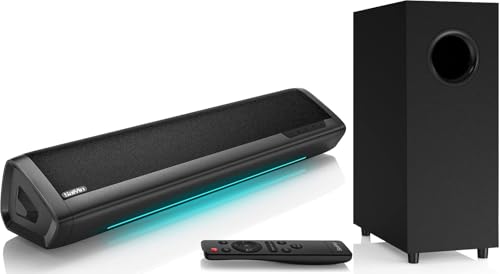


Optical Toslink Digital Audio Transmission and Compatibility
Optical audio connections, commonly referred to as Toslink or S/PDIF, utilize fiber optic light pulses to send digital audio signals from your television directly to your soundbar. This physical optical link prevents electromagnetic and radio frequency interference, eliminating the ground loop humming sounds that frequently plague traditional analog copper cables. Because optical ports have remained a universal television standard for decades, this interface guarantees compatibility with nearly every screen manufactured.
While optical connections provide pristine digital clarity, buyers should understand bandwidth constraints when comparing audio formats. Optical connections easily support uncompressed two-channel stereo PCM audio and compressed 5.1 multichannel formats like standard Dolby Digital and DTS Digital Surround. However, optical cabling lacks the bandwidth required for uncompressed lossless formats such as Dolby TrueHD or high-bitrate uncompressed Dolby Atmos streams.
When setting up your television audio output via optical connection, ensure your television digital audio out menu is configured to either Auto, Bitstream, or PCM depending on your soundbar processing capabilities. If you hear stuttering or static on certain streaming apps, switching the television optical output format to PCM standardizes the stream for seamless playback. Investing in a durable optical cable with gold-plated connectors and secure strain relief ensures the fragile internal glass fiber remains intact over years of use.
Subwoofer Architecture: Wireless vs. Wired vs. Built-in Modules
The low-frequency response of any home theater system relies heavily on the physical volume and driver diameter of the accompanying subwoofer enclosure. Compact soundbar enclosures cannot move enough air to generate tactile bass frequencies below 100 Hz without introducing audible chassis distortion. Choosing a model with a separate subwoofer offloads demanding bass duties, allowing the main soundbar drivers to focus exclusively on pristine midrange vocals and high treble details.
Subwoofers generally fall into three architectural categories: wireless external cabinets, wired external modules, and integrated internal bass drivers. Wireless subwoofers receive low-frequency audio signals over a dedicated 2.4 GHz or 5.8 GHz radio band, requiring only a wall power outlet for placement anywhere in the room. Wired subwoofers connect directly to the soundbar through a physical tether cable, providing zero wireless interference at the expense of cord routing flexibility.
Integrated internal subwoofers utilize compact bass radiators within the main soundbar body to save valuable floor space in small apartments. While built-in designs eliminate secondary boxes, dedicated standalone subwoofers consistently produce deeper extension and greater sound pressure levels for action movies and modern music. For maximum acoustic immersion, position an external subwoofer in a front corner of your room to naturally amplify bass resonance through acoustic boundary loading.
Channel Configuration and Spatial Audio Processing
Channel configuration indicates how many discrete audio channels a soundbar system produces to create a convincing soundstage. A standard 2.1 system features two stereo channels for left and right separation alongside a dedicated point-one low-frequency subwoofer channel. Upgrading to a 5.1 channel system introduces dedicated center and surround channels that dramatically broaden spatial depth during cinematic playback.
Many contemporary soundbars incorporate digital signal processing technologies such as DTS Virtual:X or virtual Dolby Atmos to simulate multidirectional audio from a compact front bar. These algorithms use psychoacoustic phase timing and ceiling reflection to trick human ears into perceiving sound sources located beside or above the seating area. While virtual surround cannot fully replace discrete physical satellite speakers, high-end DSP creates an expansive sound field that extends far beyond the television frame.
As a general rule of thumb, prioritize a true center channel if your primary goal is crisp dialogue comprehension during dense movie scenes. A dedicated center driver isolates vocal tracks from background music and sound effects, preventing speech from becoming muddled during loud explosions. If you require specialized vocal clarity, check out our comprehensive soundbar guide for dialogue clarity and hearing support for related acoustic insights.
Dialogue Enhancement and Vocal Isolation Technologies
Clear dialogue reproduction remains the most critical functional requirement for everyday television viewing and news consumption. Standard television speakers often drown out spoken words beneath heavy musical scores and ambient background sound mixing. Advanced soundbars incorporate dedicated vocal enhancement algorithms that actively scan incoming audio frequencies to amplify speech ranges.
These speech isolation features, such as proprietary voice adjustment modes or dedicated dialogue EQ presets, dynamically lift frequencies between 120 Hz and 6 kHz. By boosting this specific human vocal spectrum without raising overall system master volume, listeners can follow quiet whispered conversations clearly without getting startled by sudden commercial volume spikes. This specialized processing proves invaluable for evening viewing sessions when high dynamic spikes must be avoided.
When evaluating soundbar specifications, look for hardware that includes multi-level voice enhancement controls rather than a simple on-off toggle. Multi-stage vocal adjustments allow you to fine-tune speech clarity according to your personal hearing preferences and room acoustics. Setting the dialogue mode to medium provides balanced clarity for drama series without thinning out the rich warmth of actor voices.
Total Power Output, SPL Ratings, and Room Matching
Power output, measured in watts, dictates how effortlessly a soundbar system can fill a room with dynamic, distortion-free audio. Manufacturers often list peak power ratings, which represent maximum short-burst energy output, alongside continuous RMS power capabilities. A higher wattage rating ensures the amplifier operates with ample dynamic headroom, preventing harsh acoustic clipping during loud musical crescendos or cinematic explosions.
Sound pressure level, expressed in decibels (dB SPL), provides an accurate metric of maximum acoustic volume output across the listening area. A soundbar system generating between 90 dB and 99 dB SPL can easily pressurize small to medium living spaces without pushing internal drivers to their mechanical limits. Matching your soundbar power output to your specific room volume ensures an optimal balance between energy efficiency and acoustic performance.
For compact bedrooms and home offices under 150 square feet, a 100W to 150W peak system delivers more than adequate volume and punch. Larger open-concept living rooms spanning over 300 square feet benefit significantly from 240W to 300W multi-driver configurations paired with high-excursion subwoofers. Never run a lower-powered soundbar at maximum volume continuously, as thermal strain on small amplifiers degrades sound fidelity over time.
Acoustic Architecture and Connectivity Comparison
Evaluating core hardware specifications helps clarify performance trade-offs across different enclosure designs and connection types. The table below illustrates standard audio system profiles across common entry-level and mid-range configurations.
| System Configuration | Subwoofer Type | Primary Audio Input | Best Room Size | Vocal Enhancement |
|---|---|---|---|---|
| 2.0 Channel Compact | Built-in Radiator | Optical / AUX | Small (Under 150 sq ft) | Basic EQ Preset |
| 2.1 Channel Standard | Wired / Wireless External | Optical / ARC | Medium (150 to 300 sq ft) | Multi-level DSP |
| 5.1 Channel Surround | Dedicated Wooden Enclosure | Optical / eARC | Large (Over 300 sq ft) | Discrete Center Channel |
Reviewing these baseline architectural tiers ensures you do not undersize your sound system for a large family room. Selecting a system with discrete center driver amplification guarantees superior acoustic separation across all media types.
Secondary Connectivity Options and Wireless Streaming
While optical Toslink serves as the primary digital audio backbone, versatile auxiliary connectivity future-proofs your home entertainment investment. Modern soundbars often supplement optical ports with HDMI ARC or eARC connections, standard 3.5mm analog auxiliary jacks, and USB media playback ports. Having diverse input ports allows you to connect multiple source devices such as gaming consoles, desktop computers, and turntables simultaneously.
Bluetooth wireless integration enables seamless audio streaming directly from mobile smartphones, tablets, and personal laptops. Advanced Bluetooth revisions, including Bluetooth 5.3, Bluetooth 5.4, and Bluetooth 6.0, deliver faster pairing speeds, broader operational range, and enhanced resistance against wireless interference. Upgraded Bluetooth versions also reduce transmission latency, ensuring background music and video dialogue remain perfectly synchronized during mobile playback.
When planning your setup, assess whether your television supports HDMI Consumer Electronics Control alongside optical routing. Utilizing optical input for audio while maintaining clean device layouts creates an uncluttered media console that complements your overall home and living entertainment guides. Always verify that your soundbar includes dedicated physical input selection buttons or an intuitive remote control to switch between connected sources effortlessly.
Equalizer Modes, DSP Profiles, and Companion Smartphone App Control
Digital signal processing modes allow users to customize the acoustic output of their soundbar according to specific media genres. Standard factory presets typically include dedicated profiles for movies, music playback, sports broadcasts, and late-night viewing. Each preset modifies equalization curves, driver crossover points, and virtual surround spatialization to highlight relevant acoustic frequencies.
Movie presets emphasize deep sub-bass impact and wider surround width, while music modes prioritize balanced acoustic linearity and natural stereo imaging. Night modes compress overall dynamic range by tamping down loud sound effects while subtly lifting quiet dialogue, preventing disturbances to sleeping family members. Advanced models offer companion smartphone apps featuring multi-band graphic equalizers and custom sound matrices for granular frequency tailoring.
A dedicated graphic equalizer gives you the flexibility to compensate for uneven room acoustics, such as tile floors or bare drywall surfaces that cause treble reflections. If high frequencies sound overly sharp or harsh in your room, attenuating the 4 kHz to 8 kHz bands creates a smoother listening experience. Look for systems that support over-the-air firmware updates via mobile applications to ensure long-term audio stability and feature enhancements.
Physical Dimensions, Sound Dispersion, and Mounting Flexibility
Soundbar dimensions and physical chassis construction significantly affect both acoustic dispersion and room integration. A compact soundbar measuring between 16 and 24 inches fits neatly beneath desktop computer monitors and smaller bedroom televisions without blocking screens. Larger soundbars spanning 30 to 40 inches provide wider stereo channel separation, creating a more realistic left-to-right panning effect for action movies.
Consider the vertical height clearance of the soundbar enclosure relative to your television stand and screen bezel. Low-profile designs measuring under 3 inches tall prevent the soundbar from obstructing the lower edge of the display or blocking infrared remote receivers. Many soundbars also feature integrated keyhole mounting brackets or included wall-mounting hardware for streamlined installations directly beneath wall-mounted screens.
Acoustic dispersion angles built into driver baffles help broadcast sound evenly across wide seating arrangements. Angled driver designs project acoustic energy outward, ensuring listeners seated off-axis receive balanced sound without treble rolloff. Pairing your audio setup with well-planned seating arrangements enhances living space ergonomics, as outlined in our living room setup resources.
Remote Control Ergonomics and System Status Indicators
Everyday usability depends heavily on responsive remote control operation and clear status indicator displays. Because optical connections do not transmit volume data over standard television remotes like HDMI CEC does, soundbar remote functionality is paramount. Well-designed soundbars feature ergonomic remotes with dedicated buttons for individual bass levels, vocal boost adjustments, and input switching.
Visual feedback mechanisms on the soundbar front panel prevent confusion during everyday operation. Multi-color LED indicator lights or soft LED digital displays inform you of active input modes, current volume tiers, and EQ settings at a glance. Hidden displays that automatically dim after several seconds prevent distracting glare in darkened home theater environments.
Some soundbars offer cross-compatibility with popular streaming remotes, such as Fire TV controllers, simplifying basic volume and power commands. When installing your audio hardware, confirm that the soundbar front panel remains within direct line of sight of your primary seating position. Keeping the optical cable properly seated without tight 90-degree bends ensures consistent optical signal transmission without dropouts.
Why You Should Trust Us
Our audio review team analyzes consumer sound hardware through objective, data-driven methodology focused on real-world home performance. We systematically examine manufacturer acoustic engineering specifications, driver materials, frequency response curves, and digital signal processing architectures across all price tiers. Our goal is to provide transparent, unbiased technical breakdowns that cut through marketing jargon and highlight authentic performance benefits.
We evaluate each shortlisted model against standardized criteria including input versatility, enclosure construction, low-frequency extension, and ease of physical installation. Rather than relying on superficial cosmetic impressions, we cross-reference technical documentation, verified user feedback trends, and connectivity protocols to ensure complete evaluation integrity. This rigorous analysis ensures that every recommended soundbar delivers dependable performance and measurable audio improvements.
Our editorial team continuously tracks updates in consumer audio technology, firmware releases, and connectivity standards across the home entertainment landscape. We update our comparative guides dynamically to reflect product availability, architectural revisions, and emerging technological enhancements. You can rely on our independent insights to make well-informed buying decisions tailored to your budget and acoustic requirements.
Final Thoughts
Selecting the Best Soundbars with Subwoofer with Optical Input dramatically improves your home viewing experience by providing rich low-end impact and crystal-clear dialogue. By pairing optical digital audio transmission with dedicated subwoofer bass management, these systems overcome the acoustic shortcomings of modern ultra-thin television speakers. Investing in a properly balanced audio system creates a theater-like environment in any living room or bedroom.
For users seeking the ultimate multichannel immersion, we recommend the ULTIMEA 5.1CH Surround Sound Bar System with Dolby as our top overall selection. This powerful system delivers true 5.1 spatial processing, robust 300W peak power, dedicated VoiceMX vocal enhancement, and deep low-frequency bass via its high-excursion wooden subwoofer. Its extensive app-based graphic EQ controls and versatile connectivity make it a standout choice for dynamic movie viewing.
If you need a high-performance audio solution for smaller spaces or tighter budgets, the BESTISAN 2.1ch Sound Bar with Built-in Subwoofer represents our best compact value recommendation. Its space-saving 16.5-inch chassis integrates dedicated bass drivers, multiple EQ profiles, and reliable optical input without requiring external floor boxes. For reliable standalone wireless bass performance at an accessible price, the ULTIMEA Sound Bar with Wireless Subwoofer offers mica-reinforced drivers and wireless subwoofer convenience.
Before finalizing your purchase, consider your room dimensions, available floor space for subwoofer placement, and preferred control methods. Connecting your soundbar via optical cable ensures immediate compatibility, zero ground hum, and dependable daily digital streaming. Explore our complete collection of home audio guides in our All Reviews category hub to discover additional sound solutions for your home.
Frequently Asked Questions
What makes the Best Soundbars with Subwoofer with Optical Input better than standard TV speakers?
Modern television speakers utilize tiny, rear-facing drivers constrained by ultra-thin screen chassis, resulting in muffled dialogue and weak bass. Soundbar systems with dedicated subwoofers utilize specialized full-range drivers and large acoustic cavities to reproduce clear vocals and tactile low frequencies. Connecting via optical cable ensures pristine, uncompressed digital audio transfer directly from your screen.
How do I connect a soundbar with a subwoofer to my TV using an optical cable?
First, connect one end of the optical Toslink cable into the optical digital audio output port on your television and the other end into the optical input on your soundbar. Next, navigate to your television sound settings menu, select external speaker or optical audio out, and choose PCM or Bitstream format. Finally, power on your soundbar, switch its input mode to Optical, and adjust volume to your preferred listening level.
What is the main difference between optical audio and HDMI ARC connections?
Optical audio connections transmit digital audio data using fiber optic light pulses, which completely prevents electrical ground hum and radio interference. HDMI ARC connections utilize copper wiring and support higher bandwidth for uncompressed surround formats alongside unified remote control commands via CEC. Both connection types deliver pristine digital stereo and standard 5.1 surround sound for everyday movie streaming.
Can I control the volume of an optical soundbar using my TV remote control?
Standard optical cables only transmit audio signals and do not carry volume control data commands between devices. To adjust soundbar volume, you must use the included soundbar remote, a programmed universal remote, or compatible streaming remotes such as Fire TV controllers. Some smart televisions also allow you to configure IR blasters to send volume commands directly to your soundbar.
Where should I place the subwoofer in my room for the best bass performance?
Placing your subwoofer in a front corner of the room near your television provides natural acoustic reinforcement known as boundary loading. If corner placement causes bass to sound overly boomy or muddy, move the subwoofer several inches away from the wall or place it beside your media console. Experiment with different floor positions while listening from your primary couch to find the smoothest bass response.
What audio format should I set my TV to when using an optical connection?
Setting your television digital optical output to Auto or Bitstream allows the soundbar to decode native multichannel Dolby Digital and DTS audio tracks. If you experience silent channels, audio dropouts, or static while watching specific streaming apps, switch your television output setting to PCM. PCM format outputs a standardized uncompressed stereo audio signal that is universally compatible with every soundbar system.
Why is my soundbar not producing any sound through the optical cable?
First, verify that you have removed the tiny clear plastic protective caps from both ends of the optical cable before plugging it into your ports. Ensure the cable clicks firmly into place on both the television and soundbar, and verify the soundbar input is set to Optical. Additionally, check your television audio menu to ensure external audio output is enabled and the internal TV speakers are turned off.
Is a wireless subwoofer completely wireless or does it require cables?
A wireless subwoofer connects to the main soundbar unit wirelessly via radio frequency signals, eliminating audio cable clutter across your living room floor. However, the subwoofer cabinet still requires a standard power cord plugged into an electrical wall outlet to power its internal amplifier. This wireless architecture allows flexible placement anywhere near a power receptacle in your room.
What should I look for in the Best Soundbars with Subwoofer with Optical Input in 2026?
When selecting an optical soundbar in 2026, prioritize dedicated voice enhancement technology, robust peak wattage matching your room size, and an appropriately sized subwoofer driver. Look for modern secondary connectivity such as Bluetooth 5.3 or higher for low-latency smartphone streaming. You can compare additional home entertainment equipment across our All Reviews category hub to optimize your media setup.
Does an optical connection support Dolby Atmos audio formats?
Optical cables lack the high transmission bandwidth required for full uncompressed Dolby Atmos delivered via Dolby TrueHD. However, some soundbars use advanced digital signal processing to simulate spatial 3D Dolby Atmos sound from incoming Dolby Digital bitstreams received over optical lines. For true lossless uncompressed Dolby Atmos, an HDMI eARC connection is required.








