

Connecting two external displays to a laptop elevates creative workflow and multitasking efficiency across every professional discipline. Modern laptops offer impressive computing power, yet their compact chassis designs often lack the physical video outputs needed for demanding workstation desks.
Selecting the right hardware can prove tricky because video signal handling differs significantly across operating systems, processor architectures, and Thunderbolt standards. Many shoppers encounter unexpected display mirroring or severe resolution limitations simply because their hub cannot handle the necessary video streams simultaneously.
We compared 5 top options for September 2026 to uncover the Best Thunderbolt Docks for Dual Monitors available today. You can also explore our comprehensive tech gear reviews to discover complementary workspace solutions that streamline your daily desktop computing.



How to Choose the Best Thunderbolt Docks for Dual Monitors in 2026
Thunderbolt Protocol Generations and Total Bandwidth
Total data bandwidth determines how many high-resolution monitors a docking station can drive without compromising peripheral transfer speeds. Thunderbolt 4 provides a consistent 40Gbps bidirectional throughput, which comfortably supports dual 4K screens running at a smooth 60Hz refresh rate.
The newer Thunderbolt 5 standard dramatically increases this ceiling by delivering up to 80Gbps of standard bidirectional bandwidth and up to 120Gbps for video-intensive workloads. This massive pipe allows creative professionals to run dual 8K displays or dual high-refresh gaming panels from a single host connection.
When shopping for a workstation dock, match the dock generation directly to your laptop host controller capabilities. Investing in a higher protocol tier provides valuable futureproofing, ensuring your peripheral hub remains fully capable as you upgrade your computer over time.
macOS vs Windows Multi-Stream Transport Compatibility
Operating systems process multi-monitor video signals over a single cable using fundamentally different protocol implementations. Windows laptops utilize Multi-Stream Transport, which enables the operating system to send two or three distinct desktop video feeds through a single DisplayPort channel.
Apple macOS does not support native Multi-Stream Transport over standard USB-C connections, restricting unassisted multi-monitor docks to mirrored outputs. To achieve dual extended displays on a Mac using native hardware video, the dock must allocate two separate Thunderbolt display pipelines directly from the host GPU.
Furthermore, base-tier Apple Silicon chips like standard M1, M2, and M3 processors feature physical hardware limits that restrict native external video to one display. Always verify whether your specific Mac chip supports dual native external screens or requires specialized software emulation.
DisplayLink Technology vs Native GPU DisplayPort Alt Mode
Hardware docks use two distinct methods to send visual data from your laptop to external screens. Native DisplayPort Alternate Mode uses your computer internal graphics processor to drive displays directly with zero latency and complete hardware video acceleration.
DisplayLink docks use custom software drivers and integrated compression chips to convert video into standard USB data packets. This clever approach bypasses native platform display limitations, allowing base-tier Apple Silicon MacBooks to run two or three independent external screens effortlessly.
However, DisplayLink technology requires active driver installation, utilizes minor host CPU overhead, and does not support protected HDCP media streaming from services like Netflix. Choose native Thunderbolt docks for gaming and color-critical editing, while relying on DisplayLink models for multi-monitor office productivity.
Host Power Delivery and Charging Headroom
A capable multi-monitor dock must deliver sufficient continuous electrical wattage to charge your laptop while powering numerous connected peripherals. Standard Power Delivery 3.0 delivers up to 100W, which adequately powers most 14-inch to 16-inch ultrabooks and productivity workstations during heavy workloads.
Newer high-performance docking stations incorporate extended Power Delivery 3.1, supplying up to 140W of rapid charging directly to demanding laptop models. This additional headroom prevents battery drain during intensive rendering tasks and supports fast-charging capabilities on supported high-end notebooks.
Always inspect the external power brick wattage included with the dock to ensure it exceeds the host laptop charging rating. Premium hubs reserve dedicated wattage for front-facing phone charging ports and downstream USB accessories without reducing the primary laptop charging stream.
Physical Video Output Options and Adapter Overhead
The selection of physical video ports on the rear of the docking station directly dictates how seamlessly your monitors will connect. Premium docks provide flexible pairs of HDMI 2.1 and DisplayPort 1.4 or 2.1 ports, allowing direct cable connections without awkward dongles.
Some minimalist Thunderbolt hubs provide video strictly through downstream Thunderbolt or USB-C ports rather than dedicated legacy display jacks. While versatile, these setups require specialized USB-C to HDMI or DisplayPort cables to connect standard desktop computer monitors.
Review the input connections on your existing monitor pair before making a final purchasing decision. Selecting a dock with matched native outputs simplifies cable routing and maintains optimal ergonomic layout for ergonomic workspace comfort throughout long working sessions.
Downstream Thunderbolt Ports and Peripheral Daisy Chaining
Downstream Thunderbolt ports offer immense functional value by allowing users to daisy-chain high-speed external storage drives, audio interfaces, and secondary hubs. These versatile ports deliver full 40Gbps or 80Gbps transfer rates while simultaneously supplying up to 15W of auxiliary bus power.
Docks equipped with dual downstream Thunderbolt channels allow you to route one port to a high-resolution display and reserve the other for ultra-fast NVMe storage. This layout ensures maximum throughput for video editors and data scientists handling massive digital asset libraries daily.
If your daily workflow involves frequent file backups to external solid-state drives, prioritize docks with dedicated downstream Thunderbolt connectivity. Hubs limited strictly to standard USB-A and USB-C ports cannot support daisy-chained Thunderbolt storage arrays or external PCIe expansion enclosures.
High-Speed USB Port Distribution and Front Panel Access
A productive desktop environment requires ample connectivity for everyday accessories such as keyboards, mice, webcams, microphones, and flash drives. The best docking stations feature a balanced mix of 10Gbps USB-C ports and legacy USB-A ports to accommodate diverse peripheral generations.
Port placement plays an equally critical role in maintaining an organized, clutter-free desk surface during daily operation. Permanent cables like network cords and desktop audio inputs should remain tucked away at the rear, while quick-access charging ports and memory card slots belong upfront.
Look for integrated full-size SD and microSD card slots if your routine includes photography, video recording, or drone operation. Having high-speed UHS-II card readers built directly into the front panel saves substantial time when transferring large batches of RAW media files.
Wired Networking Speed and Ethernet Bandwidth
While modern wireless networks offer convenient flexibility, a dedicated wired Ethernet connection delivers the rock-solid stability and low latency demanded by professional environments. Standard Gigabit Ethernet ports provide reliable 1Gbps speeds, which suffice for general office work, video conferencing, and standard web browsing.
Advanced dual-display docking stations increasingly incorporate ultra-fast 2.5Gbps Ethernet controllers to support modern high-speed local area networks and fast fiber internet connections. This elevated throughput drastically reduces transfer times when accessing Network Attached Storage systems or collaborating over shared local servers.
If your creative setup relies on transferring multi-gigabyte video project files across a local network, opt for a 2.5G-equipped dock. Ensure your network switches, router, and Cat6 cabling also support multi-gigabit speeds to achieve the full performance benefit.
Thermal Management and Active vs Passive Cooling
Driving dual high-resolution displays while simultaneously routing high-wattage charging and high-speed data generates substantial internal heat inside a compact dock. Passive metal enclosures dissipate thermal energy through aluminum fins, providing completely silent operation but occasionally warming up significantly under sustained workloads.
High-end Thunderbolt 5 and multi-display hubs frequently integrate quiet active cooling fans to maintain safe internal temperatures during heavy usage. Active thermal management protects sensitive internal host controller chips from thermal throttling, ensuring stable video feeds without random disconnects.
When positioning your docking station, ensure air vents remain unobstructed by papers, books, or nearby desktop accessories. Proper airflow around the chassis extends the operating lifespan of the internal power circuitry and maintains reliable performance during marathon editing sessions.
Docking Station Technology Comparison
Understanding how different dock architectures manage bandwidth, power, and multi-display video signals helps you pinpoint the right balance of price and performance. The comparison table below highlights key specifications across the prominent docking standards available for modern dual-screen setups.
| Dock Architecture | Maximum Bandwidth | Dual Display Capability | Max Laptop Power Delivery | Primary Use Case |
|---|---|---|---|---|
| Thunderbolt 5 | Up to 120Gbps | Dual 8K @ 60Hz or Dual 4K @ 144Hz | 140W (PD 3.1) | High-end workstations, extreme refresh rates, futureproofing |
| Thunderbolt 4 | 40Gbps Bidirectional | Dual 4K @ 60Hz or Single 8K @ 30Hz | 100W (PD 3.0) | Professional office desks, creative design, MacBook Pro setups |
| DisplayLink USB-C | 10Gbps Shared | Dual/Triple 4K @ 60Hz (Driver-based) | 100W (PD 3.0) | Base M1/M2/M3 MacBooks, mixed IT fleets, standard office productivity |
Why You Should Trust Us
Our workstation gear recommendations stem from exhaustive technical analysis, comprehensive specification verification, and cross-platform compatibility mapping. We systematically evaluate interface protocols, host controller architectures, power delivery standards, and thermal performance across diverse computer operating systems.
We analyze real-world manufacturer documentation, firmware update reliability, driver ecosystem maturity, and customer troubleshooting reports to separate marketing claims from actual performance. Our editorial guidelines maintain strict independence, focusing entirely on objective data and functional workstation utility.
Our review team continually monitors evolving connectivity standards like Thunderbolt 5 and USB4 2.0 to ensure our recommendations remain accurate throughout 2026. We prioritize hardware that offers rock-solid reliability, broad device compatibility, and outstanding long-term workstation value.
Final Thoughts
Building an efficient multi-monitor desktop setup starts with choosing a docking station that matches your computer graphics capabilities and peripheral demands. Whether you manage complex financial models, edit high-resolution video streams, or enhance your modern home living workspace, dependable connectivity remains essential.
For demanding power users seeking next-generation speed and massive charging headroom, the Anker Prime TB5 Docking Station stands as our top recommendation. Its cutting-edge Thunderbolt 5 architecture delivers up to 120Gbps video bandwidth, dual 8K output capability, and rapid 140W power delivery for premium workstations.
If you need dependable Thunderbolt 4 reliability with extensive legacy monitor connectivity, the Plugable 16-in-1 Thunderbolt 4 Dock offers phenomenal versatility. With dual HDMI and DisplayPort options, 2.5Gbps Ethernet, and 100W laptop charging, it effortlessly powers dual 4K setups on Windows and modern Apple Silicon Mac computers.
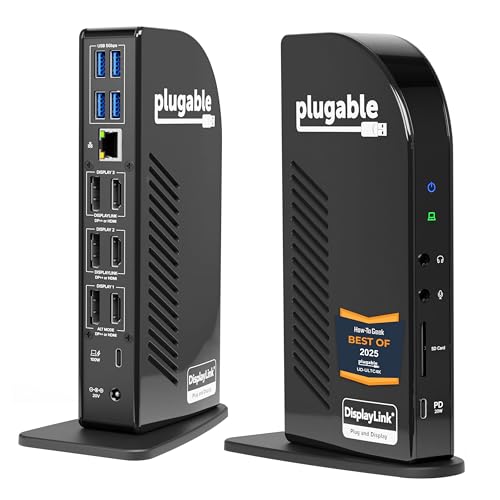
Budget-conscious professionals and base M1, M2, or M3 Mac users needing multiple external screens will find exceptional value in the Plugable USB C Triple Display Docking Station. Its integrated DisplayLink graphics engine overcomes hardware monitor limits, making it a reliable and economical choice for productive multi-display offices.
Frequently Asked Questions
Can a base M1, M2, or M3 MacBook support dual monitors with Best Thunderbolt Docks for Dual Monitors?
Base-tier Apple Silicon MacBooks feature hardware controller limits that allow only one native external display over standard Thunderbolt connections. To run dual external screens on these base models, you must use a dock equipped with DisplayLink technology or run newer base M3 laptops in closed clamshell mode.
What is the difference between Thunderbolt 4 and Thunderbolt 5 docks for dual display setups?
Thunderbolt 4 provides 40Gbps of fixed bidirectional bandwidth, which comfortably drives dual 4K monitors at 60Hz alongside standard peripheral data. Thunderbolt 5 increases bandwidth up to 120Gbps for video, enabling dual 8K displays or dual high-refresh 4K gaming screens from a single cable.
Why do some dual monitor docks require DisplayLink software drivers?
DisplayLink software compresses visual data and routes it through standard USB channels, allowing computers lacking multi-stream video support to drive multiple external screens. This allows laptops with native single-display limitations to output independent desktop workspaces across two or three physical monitors.
Do dual monitor Thunderbolt docks charge gaming laptops at full speed?
Most Thunderbolt docks deliver between 96W and 140W of Power Delivery, which is plenty for standard ultrabooks and productivity laptops. Powerful gaming laptops equipped with discrete graphics cards often require 230W to 330W, meaning you must keep the proprietary gaming power brick connected for peak performance.
How do high refresh rates affect dock bandwidth in 2026?
Increasing monitor refresh rates from standard 60Hz to 120Hz or 144Hz roughly doubles the video data transmitted across the cable. On Thunderbolt 4 docks, running dual high-refresh 4K screens may saturate the 40Gbps connection, requiring Display Stream Compression or dropping down to Thunderbolt 5 hardware.
Can I mix HDMI and DisplayPort monitors on the same Thunderbolt dock?
Yes, versatile docks such as the Plugable Thunderbolt 4 Dock feature flexible output clusters that allow you to mix HDMI and DisplayPort connections. As long as you respect the port grouping rules outlined in the user manual, you can connect unmatched monitor inputs seamlessly.
What causes external displays to flicker or disconnect randomly on dual monitor setups?
Display flickering is most commonly caused by using low-grade video cables, excessive cable lengths, or outdated graphics drivers on the host computer. Using certified high-speed cables and ensuring the main host Thunderbolt cable is plugged directly into a primary motherboard port resolves the vast majority of signal dropouts.
Is a 2.5Gbps Ethernet port necessary on a dual monitor docking station?
A 2.5Gbps Ethernet port is not mandatory for basic internet browsing, but it provides significant benefits for users transferring large media files across local networks. If you regularly back up project files to a local Network Attached Storage device, multi-gigabit networking cuts transfer times in half.
Does using two 4K screens reduce the data transfer speed of connected external SSDs?
Thunderbolt 4 dynamically allocates its 40Gbps pipeline, reserving up to 32Gbps for PCIe data while preserving dedicated bandwidth for dual 4K video feeds. While heavy simultaneous video and storage traffic shares the same overall interface, you will rarely experience perceptible speed reductions during everyday workflows.
What is the top-rated option among Best Thunderbolt Docks for Dual Monitors in 2026 for Windows laptops?
Windows laptops with native Multi-Stream Transport thrive on Thunderbolt 4 hubs like the Plugable 13-in-1 USB C Docking Station 4K Triple and dedicated Thunderbolt 5 models. These docks deliver uncompressed dual 4K or dual 8K desktop expansion without requiring background software drivers.








