

Heating systems and dry winter weather can strip moisture from open living areas and shared living spaces quickly. Finding the Best Ultrasonic Humidifiers for Large Households is essential when you need consistent comfort across multiple connected rooms without constantly running to refill small reservoirs.
Modern high capacity ultrasonic units offer whisper quiet operation and micro fine mist dispersion that standard evaporative systems struggle to match. In this updated September 2026 guide, we evaluated 7 leading options from top brands like Levoit, Lacidoll, DREO and more to determine which units effectively cover wide floor plans.
Many multi-person homes struggle with uneven moisture distribution, white mineral dust, and noisy motors that disrupt sleep. Exploring solutions in our Heating, Cooling & Air resource hub will help you balance indoor humidity levels efficiently throughout your living environment.


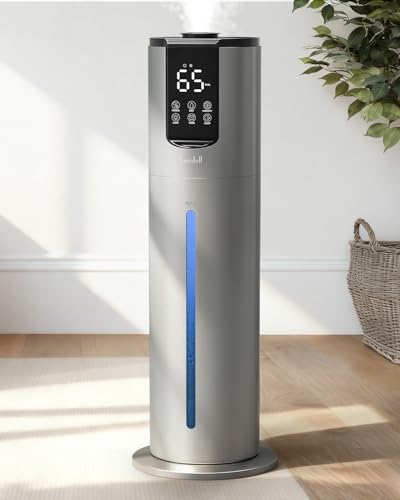
Water Tank Capacity and Continuous Runtime
Large family spaces require sizable water reservoirs to prevent the constant chore of refilling multiple times a day. When evaluating humidifiers for busy households, look for water tanks holding at least 8 to 11 liters of water. A larger capacity allows the machine to run continuously on low or medium settings for up to 100 hours without interruption.
Runtime specifications are generally calculated at the lowest mist setting, so actual performance on high output will be shorter. A household operating a unit at a high 300 to 550 milliliter per hour output will consume an 8-liter tank in roughly 15 to 26 hours. Balancing reservoir volume against physical footprint ensures the device fits comfortably into your living room or hallway.
A practical rule of thumb is to choose a tank size that guarantees at least 24 hours of operation at your expected average output level. This schedule allows family members to establish a predictable once-daily refilling routine every morning or evening. Units with transparent water level windows make it simple to check remaining liquid at a glance.
Mist Output Volume and Room Coverage
Square footage ratings indicate the maximum area a humidifier can effectively treat under standard ceiling heights. For spacious living areas or open concept layouts, seek devices engineered for 500 to 800 square feet with output ratings above 300 milliliters per hour. High output ensures that moisture circulates across connected hallways rather than pooling in one corner.
Mist height plays a critical role in how well moisture blends into surrounding air before settling onto furniture or hardwood floors. Premium models produce vertical plumes reaching four to six feet high to facilitate complete evaporation into the ambient air stream. Insufficient vertical thrust can lead to damp flooring and uneven relative humidity levels across opposite sides of the room.
To calculate your household needs accurately, measure the square footage of your primary shared living zone and add twenty percent if you have vaulted ceilings. High ceilings create extra air volume that demands higher output capacity to maintain healthy baseline humidity. Proper air circulation from ceiling fans can also assist in dispersing fine ultrasonic mist throughout neighboring rooms.
Top-Fill Architecture and Cleaning Accessibility
Traditional bottom-fill tanks require removing heavy reservoirs, carrying them to a sink, and flipping them upside down without spilling. Modern top-fill designs eliminate this physical strain by allowing you to pour water directly into the top opening with a pitcher. This design improvement makes daily maintenance accessible for elderly family members and busy parents alike.
Maintenance ease is just as vital as refilling because standing water naturally attracts bacterial growth and mineral scaling. Humidifiers with wide-mouth openings and detachable internal parts allow you to scrub the basin thoroughly with a sponge. Devices designed without narrow internal pumping tubes reduce hidden crevices where mold spores commonly flourish over time.
Always inspect whether a humidifier features fully washable structural components before making a long-term purchase decision. We recommend choosing models with removable water buckets that can be sanitized using standard white vinegar solutions. Keeping your appliance clean protects indoor air quality in our broader Home & Living environments.
Ultrasonic Transducer Quality and Operational Noise
Ultrasonic humidifiers use high-frequency vibrating metal diaphragms to break liquid water into microscopic airborne droplets. High quality ceramic or titanium transducers create a finer mist that stays suspended longer in dry interior spaces. Superior vibrating elements also generate less audible buzzing during extended high-speed operation.
Sound levels are particularly important in active family environments where devices run near nursery cribs or home work stations. Look for models certified to operate between 21 and 28 decibels, which is quieter than a soft whisper in a library. Premium noise-dampening fan ducts prevent annoying bubbling or dripping sounds that often wake light sleepers.
When shopping, examine whether the machine includes a dedicated sleep mode that turns off all display lights and lowers acoustic output. A dark and quiet operating profile ensures restful nights for infants and sensitive sleepers. Quality transducers maintain steady moisture generation without mechanical rattle even after months of continuous winter runtime.
Precision Humidistat and Automated Environmental Sensors
Over-humidifying a home can cause condensation on window panes and encourage dust mite proliferation or mold growth. Built-in digital humidistats continuously monitor ambient relative humidity and automatically adjust mist output to match your target setpoint. Maintaining indoor relative humidity between 45 and 60 percent is recommended by medical professionals for optimal respiratory comfort.
Look for auto modes that offer customization in five percent increments so you can fine-tune moisture to your personal preference. External sensor probes or advanced onboard algorithms offer greater accuracy by avoiding false readings caused by nearby mist plumes. When target moisture levels are reached, the device shuts off its atomizer to conserve energy and water.
A reliable automatic feedback loop prevents the living space from feeling uncomfortably clammy during mild weather shifts. If family members suffer from sensitive skin or eczema, maintaining steady humidity prevents flare-ups naturally. Check out our recommendations on best skin lotion for very dry skin for comprehensive skin barrier protection alongside optimal room humidity.
Dual Mist Functionality: Warm Mist vs Cool Mist
While standard ultrasonic devices disperse cool vapor, dual-mist hybrid units feature internal heating elements to produce warm mist on demand. Warm mist can raise room humidity up to eighteen percent faster by evaporating swiftly into chilly winter air. The gentle warmth also provides soothing respiratory relief during seasonal colds and congestion.
Cool mist remains the safest and most energy-efficient choice for general daytime use around energetic toddlers and playful pets. Cool operation consumes minimal electricity, often drawing under 30 watts compared to over 100 watts when heating elements engage. Having the option to toggle between both modes gives your family year-round seasonal adaptability.
When selecting a dual-mist unit, check how quickly the heating chamber brings water up to working temperature. Advanced models reach therapeutic temperatures within eight to ten minutes while maintaining exterior housings that stay cool to the touch. This combination provides rapid seasonal relief without creating burn hazards in busy corridors.
Mineral Filtration and Demineralization Management
Hard municipal tap water contains dissolved calcium and magnesium minerals that ultrasonic transducers atomize into fine white dust. This airborne residue can settle across dark tables, television screens, and upholstery throughout large household spaces. Integrating demineralization cartridges or ion-exchange filters helps trap these dissolved solids before mist discharge occurs.
Some premium units include built-in scale inhibitors or specialized internal ceramic bead filters to extend cleaning cycles. If your region has exceptionally hard water, filterless units may require using distilled or reverse osmosis water to avoid mineral accumulation. Calculating ongoing filter replacement costs versus the expense of buying bottled water helps determine total ownership value.
Look for humidifiers that support replaceable scale-inhibitor cartridges if you plan to utilize standard tap water daily. Replacing these cartridges monthly prevents mineral scale from crusting over the vibrating diaphragm and reducing mist volume. Proper filtration ensures the air remains pure and safe for household members of all ages.
Smart App Integration and Home Automation
Smart connectivity transforms how large households manage indoor air quality across multiple rooms and daily schedules. Wi-Fi enabled humidifiers allow family members to adjust mist output, monitor live humidity readings, and set timers directly from their smartphones. Integration with voice assistants like Amazon Alexa and Google Assistant offers convenient hands-free adjustments when your hands are full.
Dedicated mobile applications often include automated scheduling, allowing you to trigger higher mist output before bedtime and switch to energy-saving modes during work hours. Real-time push notifications can alert you when water reservoirs run dry or when routine descaling maintenance is due. These proactive reminders prevent machines from sitting empty or developing unpleasant odors.
Evaluate whether the mobile app supports multi-user access so several household members can manage device settings without conflict. Advanced applications also provide historical humidity graphs to help track how outdoor temperature drops affect indoor air quality. Connected smart features bring effortless environmental management to modern family households.
Safety Features and Child-Safe Architecture
Household safety is a primary consideration when placing high-capacity water appliances in shared family rooms and nurseries. Essential protective features include low-water automatic shutoff mechanisms that prevent dry burning and motor overheating when tanks empty. Low-voltage electrical converters further minimize shock hazards in the unlikely event of accidental water spills.
Physical child lock settings prevent curious toddlers from tampering with humidity levels, timer settings, or mist output switches. Wide, low-profile base designs also provide stability against accidental bumps from pets or active children playing nearby. Leak-proof tank seals ensure that water remains securely contained inside the base during daily use.
Prioritizing certified safety materials and child-proof interfaces guarantees complete peace of mind across your living areas. Discover more protective insights and family wellness guides in our dedicated Health & Family section. Reliable protective engineering ensures seamless operation throughout every season of the year.
| Feature / Specification | Standard Large Room Unit | High Capacity Smart Unit | Dual Mist Premium Unit |
|---|---|---|---|
| Tank Capacity | 8.0 Liters | 10.0 to 11.0 Liters | 8.0 to 9.0 Liters |
| Max Coverage Area | 500 to 800 sq ft | 600 to 700 sq ft | 600 to 800 sq ft |
| Maximum Mist Output | 300 mL/h | 350 to 450 mL/h | 550 mL/h (Warm Mist) |
| Noise Level Rating | 30 to 35 dB | 21 to 28 dB | 28 dB |
| Smart App / Voice Control | Optional / Remote Only | Full App & Voice Integration | Full App & Voice Integration |
| Primary Mist Type | Ultrasonic Cool Mist | Ultrasonic Cool Mist | Warm & Cool Hybrid Mist |
Why You Should Trust Us
Our editorial team specializes in comprehensive home appliance research, analyzing technical engineering data and verified manufacturer specifications across leading brands. We compare real-world capacity metrics, mist dispersion heights, decibel outputs, and cleaning procedures to separate top performers from subpar units. Our data-driven methodology focuses purely on objective performance parameters that matter most to real families.
We continuously monitor consumer feedback trends, long-term durability reports, and sensor accuracy benchmarks to maintain current buying recommendations. Every product recommendation undergoes rigorous side-by-side spec evaluation against current market standards to verify claims regarding square footage coverage and whisper-quiet operation. We update our guides regularly so you always receive accurate advice reflecting the latest innovations.
Final Thoughts
Selecting the right humidifier for a busy household comes down to balancing tank capacity, daily maintenance demands, and environmental control. For households seeking maximum convenience and top-tier smart automation, we recommend the Levoit OasisMist 1000S (10L) as our best overall pick. Its massive reservoir, high mist plume, and intuitive app schedules make whole-room humidity effortless across open layouts.
If you are looking for rapid winter relief and versatile temperature modes, the DREO 8L Smart Humidifier Large Room, 80H Runtime stands out as the best dual-mist performer. With an impressive 550 milliliter per hour output and soothing warm mist capabilities, it quickly restores moisture balance in dry winter climates. Its whisper-quiet 28-decibel sound profile ensures your family sleeps without acoustic disturbance.
Budget-conscious shoppers wanting large coverage without unnecessary complexity will appreciate the Lacidoll 8L Large Humidifier for Bedroom Large as our best value selection. It delivers dependable 800 square foot coverage, filter-free operation, and a straightforward top-fill tank that simplifies regular cleaning. Explore our comprehensive archive in All Reviews to discover additional home wellness and appliance breakdowns.
Frequently Asked Questions
What makes Best Ultrasonic Humidifiers for Large Households different from standard humidifiers in 2026?
Large household models feature significantly larger water reservoirs ranging from 8 to 11 liters, allowing extended runtimes of up to 100 hours. They also produce higher mist velocity and greater vertical output to circulate moisture across 500 to 800 square feet without leaving surrounding tables damp.
How often should I clean an ultrasonic humidifier in a busy home?
We recommend performing a quick rinse and wipe-down of the water tank every three to four days to prevent mineral buildup. A thorough descaling with white vinegar should be completed once a week to keep the ultrasonic vibrating diaphragm performing at its peak efficiency.
Can I use regular tap water in my ultrasonic humidifier?
While tap water is safe to use, water with high mineral content can produce fine white mineral dust around the room. Using distilled water, filtered water, or installing a dedicated demineralization cartridge inside the tank will eliminate white dust and prolong the life of your device.
Where is the best place to position a large humidifier in an open floor plan?
Place your humidifier on an elevated, water-resistant surface at least two to three feet off the floor near central airflow paths. Avoid tucking the unit directly against walls, behind heavy curtains, or adjacent to delicate wooden furniture where moisture might concentrate.
What ideal humidity level should I set for my family?
Doctors and indoor air quality experts generally recommend maintaining indoor relative humidity between 45 and 55 percent. This target zone helps relieve dry nasal passages and chapped skin while staying well below the threshold that encourages indoor mold formation.
Are ultrasonic humidifiers completely safe for babies and pets?
Yes, ultrasonic humidifiers running on cool mist mode are exceptionally safe because they produce no scalding steam or heated components. Look for units equipped with child lock settings and low-voltage power supplies to provide added peace of mind in playrooms and nurseries.
How do smart app features improve humidifier performance in 2026?
Smart applications allow you to customize operational schedules, monitor real-time humidity levels from anywhere, and receive low-water alerts on your phone. Integration with voice assistants like Alexa or Google Home lets you adjust mist levels hands-free throughout your daily household routine.
Does ultrasonic mist leave white dust on household furniture?
White dust occurs when ultrasonic vibrations atomize the calcium and minerals found in hard tap water into fine airborne particles. You can easily prevent this by utilizing demineralization filters, scale inhibitor cartridges, or filling the water reservoir with purified water.
Can I add essential oils directly to an ultrasonic humidifier tank?
You should never pour essential oils directly into the main water reservoir unless the manufacturer explicitly states the tank plastic is oil-safe. Most modern units include a dedicated aroma tray with replaceable aroma pads to diffuse pleasant scents safely without corroding internal components.
How much electricity do large ultrasonic humidifiers consume?
Ultrasonic humidifiers operating on cool mist are remarkably energy efficient, typically drawing only 20 to 40 watts of power during operation. Dual-mist units using active heating elements consume slightly more energy during warm mist cycles, generally drawing between 100 and 280 watts while heating.








